Packed and ready for Ray to pick me. Lulu is less enthusiastic.
Thursday, August 1
“You do you.” This from my son on our drive to the Memphis Airport. My justification for arriving at airports two or more hours before departure elicited some surprising emotional support. He’s an attorney and always ready for rational discussion. “You do you” wrapped me in a layer of confidence before this three week wandering around Alaska. I would indeed “do ME” on my trip. Atmosphere is the car was buoyant…so many reasons to be upbeat these last few weeks!
Friday,August 2, 2024
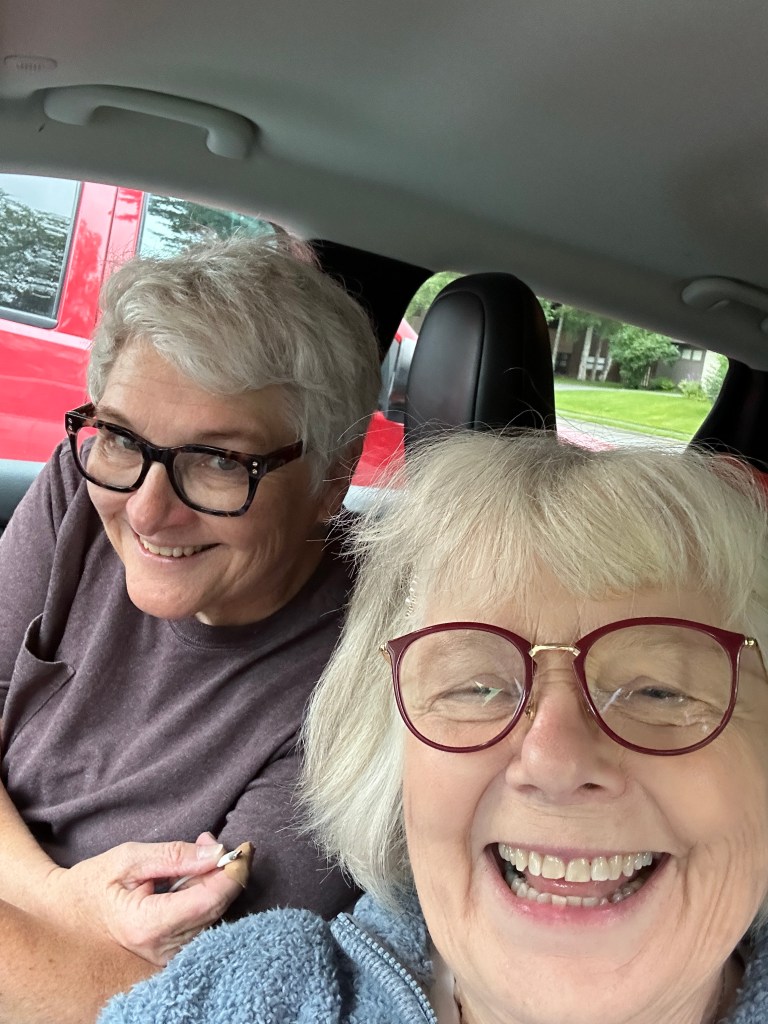
After nine grueling hours on planes and in airports, Sue Anne Jenkerson, my “play sister”, hugged me as if picking me up at 1:30 AM was no problem. SAJ plays a huge part in most of the traveling I do. Partner to my uncle for over 30 years , it gives us a unique connection. She’s actually a year younger than I am and we are both widows (I hate that word but it conveys the meaning I need at the moment).
Snow Cafe
Breakfast at a favorite place in downtown Anchorage began the day. While Sue Anne visited a friend I started on this blog while enjoying a Chai Latte at the local Barnes and Noble. Tomorrow will be preparation for the road trip!
August 5, 2024
We rested up In Anchorage and had a great visit with our hosts, the Walshes. We did some shopping for last minute paraphernalia we Might need! Yesterday it was off to the real Alaska that begins right outside the Anchorage city limits.
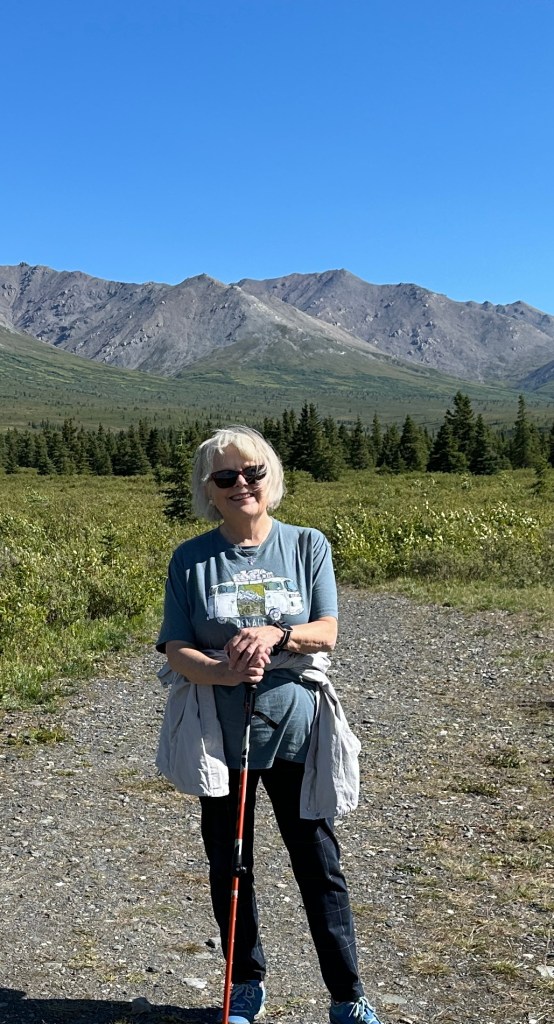
We are staying in a cozy cabin outside of Denali in a very rural town–Healey AK. This family has built three little cabins on their property and rent them through Airbnb. It’s perfect for two “widder” ladies on an adventure. We stopped to eat in Denali on the way up and just relaxed last night. Today was the first day to explore one of the areas we love most in Denali Park: Savage Creek. Some sights from today:
These clouds astounded us both so I had to Google to find out what they are: Lenticular clouds. They form when wind runs perpendicular to a mountain or mountain chain.
We hiked around the Savage Creek area, but I got an early birthday present when we saw this: the mountain of Denali. I have never seen it before in all my trips to Alasks.
My annual (except for COVID years) trips to Alaska began the year after my husband died. Sue Anne and Marvin, my uncle, urged me to come visit them but I thought I would never be a traveler. Kathryn, my daughter-in-law, told me I had never traveled so how did I know I didn’t like it! “Here is your chance to go with people who know the area. It will be a good first trip”
The beauty and magnificence of God’s world was on display everywhere and I felt myself to be one with it all. Since my first visit I have always experienced Alaska as a healing place.
August 6, 2024
Today I am 74 years old and my gratitude list is endless. I had a meaningful career and there were few days I didn’t relish the privilege of working in public education. I have a precious family with a son who is caring, concerned about doing the right thing, and always there for me. My grandsons are just plain amazing and my daughter-in-law has become my daughter over these years.
And here I am in Alaska, my healing place, my reminder of God’s omnipresence.
I have spent over a year now studying the craft of writing, practicing the craft, and submitting pieces to various literary publications. Two writing communities and two writing partners have enriched my retirement from a long career in public education. Much of what interests me is not jiving with the outside world lately, but I my writing wants a home. So this is it: Writing from the Back Porch and sometimes from the Road!
The Annual Trip to Escape Christmas
I don’t actually want to escape the birth of Jesus, just all the expectations that go with it. There is not better place to do that than Santa Fe, New Mexico. Sue Anne, known in my writing life as SAJ, is the best travel companion for me. She lets me do my thing, she loves to drive, she likes making airline reservations, she builds fires, she drives me through McDonald’s in the snow for a Diet Coke. This list is not exhaustive. A partner to my uncle for over 35 years, she is family.
We started out from her cozy home in Batesville, Arkansas, drove to Little Rock and took off for the magic land of northern New Mexico. Landing in Albuquerque, SAJ arranged our car, a nice Jeep crossover. Everything was going like clockwork and then…..she took a wrong turn (many side conversations to come about this, but not now) out of the parking lot, over many sharp spikes which promptly blew out all the tires.
Eight hours in a car can be brutal. I have learned how to make the trek from Oxford, MS to Dillard, GA a little less taxing with audio books, pod casts and a voice recorder, but at some point along every Georgia journey I start thinking about selling the cabin. “How long can I keep this up? Why do I continue to hang on to that “place”?” My questions get more pressing as I maneuver through Chattanooga traffic! Then I hit the Western North Carolina part of the trip and I start to understand my attraction to this part of the country. It’s the mountains.
What makes looking up more mystical to me than looking down? An argument exists for both. Looking down brings our attention to what is here on earth. I seem to make strong friendships with women who are master gardeners, with and without the certificate. They are fascinated by growing things and appreciating what is in the earth without their efforts. Not I. It is dangerous to look down at the ground when your mind so easily wanders like mine. As I look up at the horizon and further up into the skies, I think my mind feels most at home and I am grounded there. I remember the beloved verses of Psalm 121:
121 I will lift up mine eyes unto the hills, from whence cometh my help.
2 My help cometh from the Lord, which made heaven and earth.
3 He will not suffer thy foot to be moved: he that keepeth thee will not slumber.
4 Behold, he that keepeth Israel shall neither slumber nor sleep.
5 The Lord is thy keeper: the Lord is thy shade upon thy right hand.
6 The sun shall not smite thee by day, nor the moon by night.
7 The Lord shall preserve thee from all evil: he shall preserve thy soul.
8 The Lord shall preserve thy going out and thy coming in from this time forth, and even for evermore.
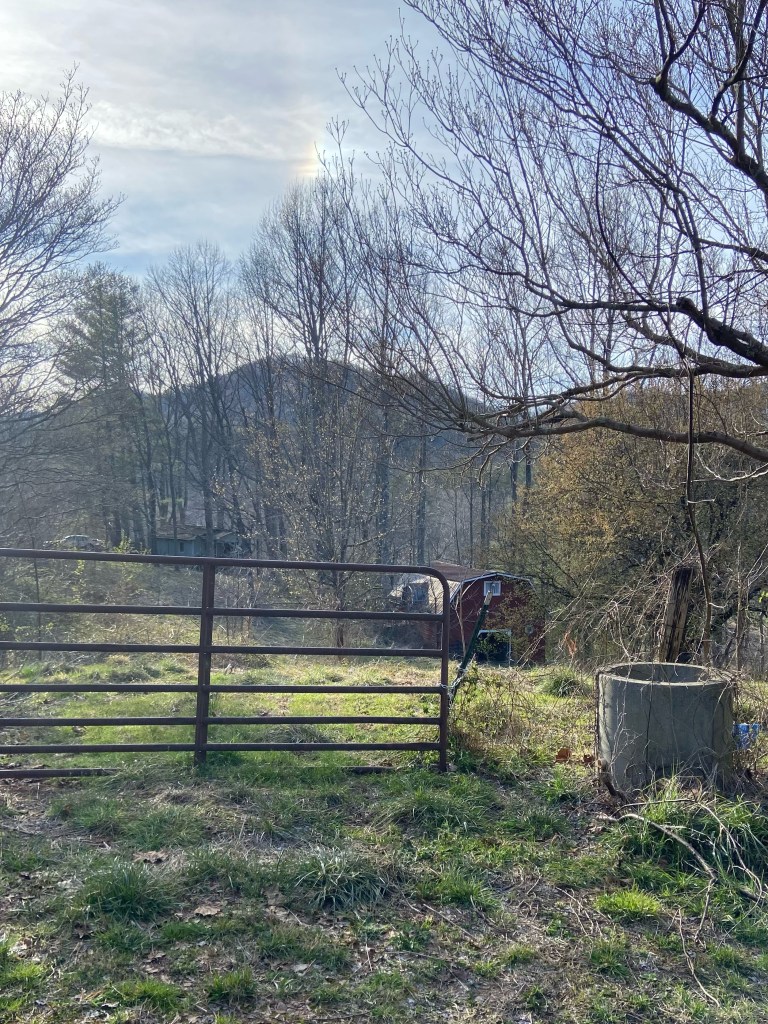
I roll along into Western Carolina and I am in the Smoky Mountains, the Great Smoky Mountains, to be more precise. I am always awestruck when the rolling hills change to mountain ranges on the horizon. The peaks seem to meet the sky and clouds can often obscure them. It is March now so the trees are still barren but even the cragginess has its own message. I know from experience that it won’t stay this way and the next time I make this trip the vista will have exploded with the colors of Spring. When I pull onto Lamb Road, I know I will not sell this year. I cannot even imagine a time when I would.
I started this blog during the dark days of 2020. I was isolated at home and watching the death rate climb and include George Floyd’s murder by the police in his hometown. These epic events collided in my mind and writing seemed my only outlet for expression. By the time I reached my last post I had a new virus: a passion for writing. I put aside my blog and found a writing coach. If I was going to write for publication I wanted to master this craft. My friend Kathleen was the perfect choice. She is an accomplished writer and writing teacher but was looking for a writing partner to get feedback on her current projects. I was and am nowhere near her level but I do read constantly so I have an idea was “sounds good” in a story. We continue to meet together weekly but I knew that I needed instruction that she did not have time to give me. I discovered that Barbara, another one of the outstanding women I know, was also aching to write and had signed up with Nadine Kennedy Johnstone and her community of women writers. Nadine is a writing professor, author, and coach and she has inspired me to learn a craft I have dreamed about since I was in the fifth grade. I “work-out” my writing every Monday at noon with an exceptional group of supportive women online. I also sign up immediately when Nadine offers another Publish the Personal classes. She has taught us the importance of submitting our work, over and over again if necessary. So far I have only been rejected, but I have learned that the life of a write contains many rejections!
Over the last few weeks I have played with the thought of relaunching my blog and having a space where I can “try out” what I am learning and share it with others. So I am back! I will post at least once a week and you can read my musings from the back porch.
“Read, read, read. Read everything – trash, classics, good and bad, and see how they do it. Just like a carpenter who works as an apprentice and studies the master. Read! You’ll absorb it. Then write. If it’s good, you’ll find out. If it’s not, throw it out of the window.” –William Faulkner
Oh little town of Bethlehem, how still we see thee lie Above thy deep and dreamless sleep the silent stars go by Yet in thy dark streets shineth, the everlasting light The hopes and fears of all the years are met in thee tonight.
The week began with the shortest, the darkest day of the year, the Winter Solstice. It will end with the Christ Light. Advent, a time of waiting and expectation on the Christian calendar, draws to an end. The pandemic of 2020 has been one long Winter Solstice for so many people. My small life of retirement has grown even quieter. I have turned inward to explore unmet dreams, regrets of lost years, and the realization of life’s impermanence. The injustice that permeates the lives of the poor, the displaced, and the oppressed has become for me emblematic of the dark streets of Bethlehem. I have been wandering these streets for many months in search of light.
On the four Sundays of Advent, we light a candle. Each candle represents what humans search for all their lives: hope, faith, joy, and peace. These desires are universal and are not changed by anyone’s religiosity or lack of it. Those in poverty or living in affluence want lives full of these attributes. The masters and the slaves want these things. The lost and the found want these things. It is with great expectation that we light these candles, but they will not come alive without the Light. On Christmas Day we light our final candle. It is the white Christ candle and suddenly our Advent wreaths are blazing and alive and real.
We need that Light going forward in 2021. There are stark needs on these dark streets. We must come together in groups, large and small, most especially in our churches, and build the trust to turn the Light on these needs. We can use the Light’s power to be honest, to own our own part in the darkness, and the way forward will emerge. The dark streets will be ablaze so that faith, hope, joy, and peace will be a possibility for all!
“After this I looked, and there before me was a great multitude that no one could count, from every nation, tribe, people and language, standing before the throne and before the Lamb…….they are before the throne of God”. Revelation 7:9
and he who sits on the throne
will shelter them with his presence.
‘Never again will they hunger;
never again will they thirst.
‘he will lead them to springs of living water.’
‘And God will wipe away every tear from their eyes” Revelation 7:15-17
“How could whites confess and live the Christian faith and also impose three-and-a-half centuries of slavery and segregation upon black people? Self-interest and power corrupted their understanding of the Christian gospel.” James Cone in The Cross and the Lynching Tree
In these quotations we see the horror that can occur when we don’t live the theology we proclaim. I see race as the crucible of the white church and I am seeking a path to begin again. That path must be a redemptive one.
I live in a Mississippi college town well known for its authors, musicians, beautiful old homes, quaint square, and its food. The mainline Protestant churches are represented about 2 blocks from the iconic Square Books. You can take a walking tour from the bookstore and easily find the first stop at the historic building of the First Presbyterian Church. The Episcopal Church is cozily ensconced across the street and is in the middle of an expansion. The United Methodist Church is located behind First Presbyterian and sports a beautiful family life center. First Baptist Church is located a block further down the street and likely has the biggest congregation. All of these churches are predominately white in congregation and style.
I was baptized in the Catholic Church, confirmed and married the first time in the Episcopal Church, baptized again in the Baptist Church, taught Sunday School and youth groups as a member of the United Methodist Church, and am currently an elder in the Presbyterian Church. This kind of eclecticism has its roots in my family.
My mother had a fairly rebellious attitude toward religion. She frequently got in trouble by reading books off the Pope’s banned list and loved to tell the story of draping a cloth over her cleavage while taking communion before the Prom. She was pretty, popular, had a beautiful voice so she was often in performances. In high school she was starring in something and her twin sister got in trouble with the nuns and was sent somewhere for detention. Mother went on strike until her sister was released. I have inherited from her much of my questioning nature and reluctance to take orders from anyone.
My father was active in the Baptist Church from infancy. When they were married my parents continued to attend their separate churches until I was seven and they joined the Episcopal church where they were active members until their deaths. My father taught Sunday School for youth and adults all his life. He loved history and theology and the church. I inherited those passions from him.
I tell this story because I want to confirm my own love and understanding of organized religion and the role it plays, especially in the South. I will be a member of my church for all of my life, too. I feel that gives me the right and the responsibility to chastise it at this point in our history. In previous posts I have acknowledged all that I have had to learn about the history of Black people in our country, and the story of racism in my own family in order to arrive at the deep disappointment I feel in the church and in myself today. In Paul’s second letter to the Corinthians he described this feeling. “For godly grief is a natural response to the suffering of others.”
The white church has a long history of being complicit in racism. (Tisby, 2019) There should be no doubt that white Christians have failed to walk their talk. The opening quotes from Revelation and James Cone show dramatic imagery that portrays the vast chasm between faith and actions.
The book of Revelation is a complex, controversial book in the Bible. It is full of powerful imagery consistent with the Christian theme of the time: Jesus will come again and soon! My purpose here is not to debate anyone’s interpretation of Revelation, but to use the imagery to explain its power to catch the theological imagination of people. Regardless of where one falls on the spectrum of Biblical authority, it is clear in the scriptures that Christians believe deeply in a God of justice, love and mercy. At least we say we do.
The second quotation comes from James Cone in his book, The Cross and the Lynching Tree. Cone is well known for his understanding of Black theology and its relationship to Black Power and liberation. The image created by the Cross juxtaposed to the Lynching Tree is a condemnation of white supremacy. If we say we believe the words in the scripture but we perform the acts described by the Lynching Tree, it takes a lot of mental and emotional gymnastics to reconcile that with our faith. White supremacy on the surface today seems to be associated with Nazi symbols, Klu Klux Klan, and particular people who tout their superiority on the internet. But white supremacy goes much deeper than those symbols which are easy to reject or dismiss. It describes a belief that white people are superior and because of that they deserve the power they have in any situation. That belief has infused the church since colony days just as it has our country. And it is still alive today.
The recent election proved once again that we are a very divided country across a wide variety of social and political issues. That said, race was a major factor in this election. Black Americans can rightfully claim they made the most significant difference in these results. The election took place with racism permeating events. COVID infection and police malpractice impacted Blacks at disproportionate levels. Once again historical events have collided and revealed the continual struggle for Black Americans to gain their full citizenship rights in our country.
I heard a Black woman interviewed on television explain why, for forty years, she has never voted. Until this week. She said something like this: “I have always thought that this country did not accept me. But after the social protests of the last year, I have started to believe that this IS my country. I should start participating, learning the system, and voting.” For the first time in forty years, this woman has some hope about America. Does that sound familiar? Dramatic displays of violence against Blacks, shock throughout the nations, mobilization of protests, and hope “springs eternal”. I imagine that her hopes are even deeper and wider today. There have been other moments like this in the history of our country. The Emancipation Proclamation, Reconstruction after the Civil War, and the Civil Rights movement of the 60’s were all times of great hope for Blacks in this country. None of these moments led to the kind of acceptance or the legal rights they promised. Another moment has arrived when Black Americans are hopeful and anxious for promises to be realized.
Perhaps that is how Martin Luther King felt in 1963, standing at the Lincoln Memorial and looking out on 250,000 people during the March on Washington. He described his dreams for his children on “the red hills of Georgia.” This was a prophetic speech from a well of deep faith by a gifted Baptist preacher. This moment was the high point of the movement and King’s influence on nonviolent protest. The speech and the movement itself were fueled by King’s deep belief in the beloved community, a community not unlike what is described in the scriptures above.
Perhaps it was how Clarence Jordan felt as he journeyed back to his home state of Georgia after earning a PHD in Greek New Testament from Southern Baptist Theological Seminary in Louisville, Kentucky. It was 1942 and instead of entering church leadership as King would do in 1954, Jordan and his wife bought property with Martin and Mabel England, near Americus, Georgia and started Koinonia Farm. The farm was to be a “lived theology” where Blacks and whites would abide in community, interdependent and sharing their resources. Jordan did not march or protest, he created a place where the beloved community could live.
King and Jordan fit the definition of prophets who represent marginalized people and call for their inclusion in the larger community. King chose nonviolent protests and community organizing. Jordan chose to build an alternative community as a powerful example of that inclusion. Both felt called by God to walk their path in the face of sometimes violent opposition.
King believed, at least at the beginning of the nonviolent protests, that the end would be redemption, reconciliation, and the creation of the “beloved community.” But by the late 60’s “the vision of the beloved community lies in ruins”. (Marsh, 2005) Although there had been legal progress for sure, the barriers now seemed more related to the values, attitudes, and beliefs of whites which proved much harder to change. (Marsh, 2005)
Jordan ran into those same white values, attitudes, and beliefs in the community around Koinonia Farm in Sumter County, Georgia. From 1942-1949 Jordan and England built the Koinonia Farm from the hard scrabble of South Georgia and developed an interracial enterprise buying and selling farm products in the area. The farm was organized by a covenant that required sharing in everything. Blacks and whites ate together and worked together equally. The reaction to this simple parable straight from Jesus’s example was hate and violence.
Perhaps a way forward for the white church may be found in the story of these two ministries. I will continue to search in that direction and share what I learn in future posts.
“in the early decades of the century, white southerners had stolen reconstruction from the Negro and given him Jesus instead” Charles Marsh
From 1877 until 1965 Blacks and whites in the South lived in a segregated society kept in place by Jim Crow laws, cultural norms, and fear. Blacks and Whites read the same Bible and ministers preached sermons supposedly based on the same scriptures. Yet, culture of racism and white supremacy was obviously too strong for white Christians to resist.
Reconstruction began with the Emancipation Proclamation and was over by the end of 1877. (Foner, 2014). During those fourteen years public schools were established and Blacks had access to education for the first time. Equally as important to the creation of community was the Black church. During slavery Blacks were allowed entrance to churches but relegated to the balconies or back seats with no role in governance. But they heard the message and it appealed to a people locked in bondage. I imagine that it was comforting to identify with the Old Testament story of a people brought out of oppression and lead into a promised land. The New Testament Jesus who brought a message of hope, faith, mercy and justice were surely a balm to a tormented soul. Reconstruction brought the opportunity for Blacks to form their own churches and those churches became the center of a stable Black community.
By 1877 white supremacy was reestablished, black codes in place, and whatever hopes and dreams the Black community had after 1863 were gone. The white Northerners were tired of the drain on their pocketbooks and their political will and the white Southerners were back in power. The Blacks were left with the solace of an afterlife that promised something better, a convenient way for whites to “keep them happy”. Meanwhile the whites had sold their own souls.
The word that seems best to describe this post Reconstruction time in the white church is “silence”. White church men and women accepted the culture as it was. They bought into what Eddie Glaude calls, the “lie” of Black inferiority and benefited once again from Black labor. It is difficult to see one’s family, one’s ancestors, as oppressors, but we were and still are in many ways. What was happening in the Black church? The church folks were talking.
In our homes, in our churches,
wherever two or three are gathered,
there is a discussion of what is best to do.
Must we remain in the South
Or go elsewhere? Where can we go
to feel that security which other people feel?
Is it best to go in great numbers or only in several families?
These and many other things are discussed over and over.
A colored woman in Alabama, 1902
The Warmth of other Suns:the epic story of America’s great migration
Isabel Wilkerson
In her beautifully written, almost lyrical book, Isabel Wilkerson tells the stories of the Great Migration. Between 1915 and 1970 six million Black southerners let their homes to resettle in places all over this country, anywhere but the South. “By the turn of the 21st century, blacks made up a third of the city’s residents with more blacks living in Chicago than in the entire state of Mississippi.” (Wilkerson, 1990) They decided to “begin again” elsewhere (to borrow another term from Eddie Glaude, Jr.). But there were also Black people who chose another strategy. They stayed and began to make some noise with the encouragement of people like Martin Luther King, John Perkins, and Ella Baker. Baker’s biographer, Barbara Ransby (2003), calls the period from “the nadir of segregation at the turn of the twentieth century to the peak of the civil rights movement in the 1960’s and beyond” as the Black Freedom Movement. We need to analyze the reaction of white people to this cry for justice and to search for where faith was a part of that freedom movement. The Church needs to lead a movement of its own.
When I ride by the downtown churches of my small southern town these days, I wonder how we reconcile what we say in our worship services with what we do in response to the inequities in our society. These mainline churches represent the major Protestant churches in America and all of them have national organizations that do have prayers, confessions, policies, that address these concerns. But at the local level where we all are visible to our neighbors, we are very quiet.
A quick look at the Sunday bulletins from these churches reveals that they include offering collections. A look at the budgets will show donations to the homeless, the hungry, and other such causes. But more of the funds will go for staffing the churches with various ministers to lead programs, primarily for the members themselves. They have nice facilities, some being expanded, that must be maintained. In some programs the people of these churches actually touch the hungry, the homeless and the oppressed, but more often they touch each other.
At some point in the programming of these churches, including my own, white Christians have studied the Old and New Testaments in small and large groups. The Old Testament tells of the creation of the world, the deliverance of God’s chosen people in Israel from the hands of their oppressors, and the many times God sent prophets to tell the chosen they needed to “act right”. The New Testament tell the story of Jesus, the living presence of God, and the creation of the church as the vehicle to spread the message, the “good news” of transformation, to everyone. The denominations represented in my town’s enclave of downtown churches may take different attitudes toward these scriptures. Some interpret all of it literally and others take in as authoritative in its message, but still a product of human beings who are not infallible. Regardless of the perspective, all should agree that anyone claiming to be a Christian would see that oppression should be overcome. This message cannot be in doubt when we read these samples of scriptures:
“After a long time the king of Egypt died. The Israelites groaned under their slavery, and cried out. Out of the slavery their cry for help rose up to God” Exod. 2:23
“He has shown you, O mortal, what is good. And what does the LORD require of you? To act justly and to love mercy and to walk humbly with your God.” Micah 6:8
Blacks groaned under slavery, they groaned post-Reconstruction, they protested and mobilized during the Civil Rights movement and here we are again in 2020. How can we white Christians “begin again”?
I Will Lift Up Mine Eyes to the Hills Julius Bloch
Philadelphia, PennsylvaniaWoodmere Art Museum
“I lift up my eyes to the hills. From where does my help come? 2 My help comes from the Lord, who made heaven and earth?
Psalm 121:1-2
I have lifted up my eyes unto the hills every morning of my retreat in the North Georgia mountains. The natural world has always been my place of contemplation and the mountains set the perfect scene. Julius Bloch was a German-born immigrant whose family came to the United States in 1893. They experienced great hardship when they settled in Philadelphia. He always identified with the working class and others who suffered. This propensity led him to paint sensitive portraits of Blacks in the Philadelphia community. This particular painting awakened my desire to explore where faith and racial justice intersect.
My faith has been nurtured within the traditional church. My mother grew up in a Catholic household and my father in a Baptist one. Neither of their mothers was happy with the union. This “mixed marriage” exposed me to very different faith cultures in my early years. While I went to Mass with my mother, my father stayed home with my sister and later took his turn at church on Sunday nights. Eventually we all joined the Episcopal church so we could worship as a family. In high school I would attend church with my family in the morning and go to the Baptist church youth program Sunday evenings. In college I was attracted to an evangelical group, but two marriages later I am solidly mainstream in the Presbyterian Church USA.
I love the Church, with a capital C. It is the only institution in our modern society that still focuses on the spiritual development of people. But I am also very disappointed in the Church today and its reluctance to part ways with the American culture of individualism, competitiveness, and even racism. I keep waiting for a new Amos, a new prophet, to appear and call us to task. Where is a new Jeremiah who will call us out for our refusal to acknowledge our privilege and use it to better the world for all people?
Martin Luther King, Jr. may have been the prophet we needed in the 1950’s. He came back to the South to become a Baptist minister at Dexter Avenue Church in Montgomery, Alabama. He said once he always thought of himself as a Baptist preacher like his father and grandfather before him. Like all of the Old Testament prophets he was reluctant and did not have activism as his personal agenda. The times came to him, the people came to him, I believe God came to him, and he responded.
Another Baptist preacher, a white one this time, came back South, too. Clarence Jordan took another approach. He did not lead a church, but formed a community, Koinonia , in South Georgia. He heard God’s call to show how faith can change the world from the inside out.
These two men, one white and one Black, reveal two paths to racial justice, redemption, and reconciliation. These paths often seem in conflict in the civil rights movement of the 1950’s. The essential energy in both movements was faith in a God of righteousness and focused on the cross, the sacrifice, the suffering of a man who came to show us “the way”. There are other valuable kinds of movements and energies, I am sure, but the Church should stand for ours and respond to the pain and suffering so prevalent around it.
This is the first installment and introduction to a series on the topic of Faith and Justice.
References for this series will include:
The Beloved Community: How faith shapes social justices, from the civil rights from the civil rights movement to today. Charles Marsh
Ella Baker and the Black Freedom Movement: a radical democratic vision Barbara Ransby
Reading Romans Backwards: a gospel of peace in the midst of empire Scott McNight
Interrupting Silence: God’s command to speak out Walter Bruggeman
Do you rulers indeed speak justly? Do you judge people with equity? 2 No, in your heart you devise injustice, and your hands mete out violence on the earth.
3 Even from birth the wicked go astray; from the womb they are wayward, spreading lies. 4 Their venom is like the venom of a snake, like that of a cobra that has stopped its ears, 5 that will not heed the tune of the charmer, however skillful the enchanter may be.
Psalm 58:1-5
A Black man once told me that I lived, not in real life, but vicariously through books. That was said over 30 years ago, but it still stings. This tendency of mine, though, has been in full expression since the isolation began. Books of all genres have compelled me to understand our country’s past and my own. Reading Kiese Laymon’s memoir, Heavy, left me undone.
Oftentimes good literature disturbs us. It transports us beneath the surface of another’s life and we experience their reality. Heavy thrust me into the life of a Black man the age of my son. Laymon was born in Jackson, Mississippi, six weeks before my son in Starkville, Mississippi. Both were bright young men with futures so different it broke my heart to absorb Kiese’s reality and know it to be true.
Laymon wrote his memoir as a message to his mother. His relationship to her was the foundation of his life. A tall, full-throated Black man, a playwright and professor, told me years ago that “boys have no choice but to love their mothers.” The plays he wrote depicted a Black life similar to Laymon’s: full of pathos, joy, rich language, and abuse.
The best way I can understand Heavy is to see it as the lament of a Black man reflecting on his life. It is common these days to hear the media talk about Black people dying of COVID due to “underlying conditions.” Those “conditions” are heavy, Laymon was saying. The most powerful condition is being Black in America. His lament cried out as the psalmist does, “Do you rulers indeed speak justly? Do you judge people with equity? No, in your heart you devise injustice and your hands mete out violence on the earth.”
Laymon was physically abused by his mother. He understood in his 40’s the frustration and rage, the loneliness, that tormented her. Her brilliance, what Kiese might call her Black abundance, was never appreciated by the white world of academia. This never-named woman loved her son and wanted to discipline his mind and body for what it would take for him to succeed in the same white world she found so cruel. But the child’s body only felt pain at the hand of the one he “had no choice but to love.” Kiese’s memories were steeped in a pain, a Mississippi Blackness, that set it apart from other stories of childhood abuse. The pain was inescapable, it was thick in the atmosphere of his life and his mother’s. And it was oh, so heavy.
The year my son matriculated at Davidson College in North Carolina, Kiese did the same at Millsaps College in Jackson. Both were drawn to liberal arts colleges with vibrant intellectual cultures. My father had gone to Davidson and his grandson was able to finish college with no debts. Kiese had to work, often did not have food, and was surrounded by White people. He rarely went to class but read all the assigned books, took Latin, and Women’s Studies. After months of study and the opening of his mind, he felt he knew enough to write about something he probably had felt most of his life. Now he thought he had words for it. He wrote an essay for a class about “Institutional Racism at Millsaps.”. When the student newspaper published it, a series of frightening events and reactions made it very clear to Kiese that he had lit a fire he didn’t completely understand. His mother had warned him, “They will try to shoot you out of the sky.” His other Black friends wanted him to shut up and get his degree, organize and make changes that way. A friend of his mother said, “ You wasting your time fighting rich Mississippi white folk for free. You can’t fight these folk with no essay. You ain’t organized. You aint got no land. You ain’t feeding no one with that sh_____ you writing. What is it you want White people to do, and how is whatever they do after reading that essay going to help poor niggas in Mississippi. That’s the only question that matters.”
He became a pariah to the White student body and the paper was shut down for ten weeks while new guidelines were developed. Ultimately, Kiese was expelled because he took “The Red Badge of Courage” from the college library without checking it out.
Laymon transferred and graduated from Oberlin College, received an MFA from Indiana University Bloomington, and landed a professorship in Poughkeepsie, New York, at Vassar College. The power and shame of addiction permeated Kiese’s life. He had been obsessed with his weight since he was twelve years old and weighed 213 pounds. He would gorge himself with food to manage his anxiety and continue until he punished himself. When he weighed in the 300 pound range, he would use intense exercise and starvation to lose the weight. Throughout these cycles, he wrote, taught classes, mentored students, and dealt with the white culture of Vassar College.
The white professors in his department repeatedly told him how lucky he was to be on the faculty. Laymon wondered if the Black faculty members at Jackson State told his mother how lucky she was to teach there.
Black students at Vassar gravitated to Laymon and he treated them like his family. Maizie was one of those students. He helped her appeal a suspension she received for threatening a roommate who “disrespected” her mother. With his assistance the suspension was reduced to banning her from the dorm and library after dark.
A white boy was brought before the judicial council, when Laymon was the only Black member, because security had found “felonious” amounts of cocaine, a scale, and baggies in his room. He was charged with possession and intent to distribute the drugs. He defended himself by describing a “big, dark man” who had made him use cocaine in a nightclub. Despite the dissension of Laymon, the council decided to practice what they called “transformative justice.” One of the white members declared that “we don’t know what he went through”. The result was no action taken against the boy.
“I thought about how even when we weren’t involved in selling drugs, big, dark folks like us could be used to shield white folk from responsibility….I’d look like a big, dark, black man since I was an eleven year old black boy. I’d been surrounded by big, dark, black men since I was born. I never met one big, dark, black man who could make a white boy buy cocaine. Apparently, there was one such big, dark, black man in Poughkeepsie, New York.”
At some point Kiese began to see himself as another Black man doing hard work in order for white people to prosper. “And some of us if we were extra lucky, would get to teach these small, smart, addicted white boys and girls today so we could pay for our ailing grandmother’s dental care tomorrow”.
Laymon’s memories should make it possible to see the protests in our country, sparked by the killings of Black men at the hands of policemen, as the outpouring of anguish, rage, sorrow, and exhaustion pent up over generations. Heavy ends with ambivalent prose and poetry. “We may remember, imagine, and help create what we cannot find.” Or we will not.
Kiese Laymon is now back in Mississippi and is a professor of English and Creative Writing at the University of Mississippi.
Laymon, K. (2018). Heavy: an American memoir. New York, NY: Scribner.
“Do the best you can until you know better. Then when you know better, do better.” Maya Angelou
“They are going to kill me……….I can’t breathe……please.” George Floyd
“How long can Black people love this country when it doesn’t love us back”. Doc Rivers, Buck’s coach
The historical inquiry about my country and my family has created a new lens I hope I can use to better understand what is happening around me. But I don’t want to stop at understanding. I want to “do better”. The murder of George Floyd, a Black man, happened in the middle of a global pandemic and crippled economy. The disproportionate effects of these conditions on people of color has created great suffering and few of us have been spared from the sorrow. We must continue to do the hard work of exploring the nation’s past and our own pasts, if we want to create a new future that is more equitable and inclusive.
I am a recovering school superintendent. I retired four years ago after a 34 year career in education that culminated in a nine year stint as a superintendent. Thus, began the second half of my life and I am convinced this can be a period of transformation. But I must be willing to work hard at understanding the deep patterns in the first half. Richard Rohr, a Catholic mystic, writer, and philosopher calls this process, “falling upward”. We go down, we may even suffer in doing that, but we are able to go upward again. We can explore new ways of being in relationship with the world as well as new solutions, and new dreams.
Eddie Glaude, Jr described this time in our country as an “after time”. We are experiencing great upheaval, a great fall. As a nation we have an opportunity to “fall upward”, to take this opportunity for transformation. I am not a historian, a medical professional, or a politician. I am an educator. How might a second half of life transformation happen within the context of the world I know best- public schools?
Earlier in my blog posts, I introduced the framework of a ladder to represent systemic racism. This ladder exists within all the institutions that hold up our nation.
Most every school district I know has a vision statement. I have led many groups in creating these descriptions of an ideal state. I imagine that these words could describe the ideal conditions on the ladder, and how those experiences impact the lives of the teachers and students on it. Here is part of one vision:
“Students will be highly engaged in the learning process and see the relevance of their educational experience to the rest of their lives. Educators will have a deep understanding of what students should know and be able to do. They will be designers of differentiated, relevant and rigorous work and active members of thriving professional learning communities. The culture of the organization will not allow failure to be an option for students, and the school system will be the strongest equalizer in the county. Regardless of economic status, ethnicity, or cultural background, all students will receive the opportunities necessary for their success in life.”
My first year as principal 1999-2000
I would suggest that all schools and school systems would want this to be a result of their hard work. Teachers and leaders want school experiences to open doors to “good lives” for all their kids. They do not lie awake at night and dream up racist behaviors that they can unleash the next day. The problem is that all those good intentions do not result in open doors for a disproportionate number of Black and Brown boys and girls. We see that clearly in all kinds of health and wealth statistics. We see it clearly in our school data. We see it, we see it, we see it.
Maya Angelou tells us, “Do the best you can until you know better. Then when you know better, do better.” Seeing the results in data and statistics is not the same as knowing what it means. Knowing comes from being involved in the stories and with the people behind the data. Seeing is a clinical exercise, but knowing creates discomfort and disturbance. We cannot do better until we know better. Then doing better will take courageous leadership, courageous followership and effective strategies.
In the days ahead, I will try to connect historical inquiry, my personal journey, the literature of Black writers, and what I know about public schools. In my second half of life, I want to give whatever hope I can to students, families, and the educators who care about them. We can know better and we must do better.















 delloruth.com